


Grass Review: What Sharing Your Bandwidth Actually Earns
Grass reviewed: who runs it, what the app does with your connection, Uptime and Network Points, the 5,000-point referral bonus at 100 hours, what Airdrop One paid, the internet-provider and privacy catches and who should skip it.
Last updated 24 October 2026
Best for
People with an unmetered home connection and an always-on computer or Android phone, whose internet provider allows sharing the connection, and who treat points as a free lottery ticket rather than income.
Grass pays you in points for letting its network route public web requests through your home connection, and those points have no cash value unless the Grass Foundation turns some of them into GRASS tokens. It has done that once: Airdrop One gave 9% of the token supply to early point earners, claimable from October 2024, and GRASS traded at about $0.64 on 24 October 2026. Our code adds 5,000 Uptime Points once you reach 100 hours online, which on its own lifts you past the Silver rank. Running it costs only electricity and data, but Grass's docs schedule no further reward, other people's traffic leaves through your IP address, and your provider may forbid it. Install it on an unmetered connection if you're comfortable with that trade; skip it if you need predictable money or your contract bans sharing your connection.
Pros
- Free to run: no deposit, purchase or subscription
- 5,000 bonus Uptime Points at 100 hours through our code
- Runs in the background on Windows, Mac, Linux and Android, and pauses whenever you like
- Android earns a 3x and the desktop apps a 2x Uptime Points boost
- Points have turned into tokens before: Airdrop One distributed 100 million GRASS
- Grass says it only routes public web requests and can't see what you do on your device
Watch-outs
- Points have no cash value and can't be sold, transferred or redeemed
- Grass's docs give no date, size or conversion rate for any future airdrop
- Other people's web requests leave through your home IP address
- Your internet contract may forbid sharing the connection, and that risk is yours alone
- Using a VPN to get around country restrictions is banned
- The browser extension is rated 2.5 from 2,900 ratings, with recent complaints that nodes stopped earning
Current related offer
Grass offer pageReferral links: BitBoni may earn a commission when you sign up.
Provider
Grass
Sign up to Grass with referral code XFHjZBD2GZAwT6I and earn Grass Points for sharing your unused internet bandwidth. New referrals get a 5,000 Uptime Point bonus after reaching 100 hours of uptime, and points feed into periodic Grass Token airdrops of speculative value.
Requirement: No deposit; keep the app connected to accrue points (100 hours uptime unlocks the referral bonus)
KYC countries: No KYC; open everywhere except 25 countries
Easy5 minutes to sign upPayout Points accrue continuously; tokens are distributed via periodic airdrops
Verified 24 October 2026
Full claim instructions are on the Grass offer page.
What Grass is and who runs it
Grass is a network that rewards people with points for sharing internet bandwidth they aren't using. The Grass Network routes and verifies public web requests through those connections and turns the results into structured datasets for AI and enterprise customers. Grass OpCo Ltd, a subsidiary of the Grass Foundation, runs the apps, dashboard and websites, and the Foundation's own site handles GRASS token claims and staking.
It is big: the download page counts more than 8.5 million users, and the Chrome extension alone has 900,000. Nothing in it costs money and nothing needs a deposit. What you give is electricity, data allowance and the use of your IP address.
What it does on your device
Once connected, your device acts as a node: it relays encrypted web requests, approved by Grass's validators, to public websites and passes the responses back. Grass says the network doesn't use your computer or see what you do on it; it only routes traffic through your IP address, separately from your own browsing, and only collects public web data.
Its Network Use Policy says only verified, legitimate businesses can buy access to the network. Even so, the websites on the other end see your home IP address making requests you didn't make. Keep Grass off work devices and anything you can't secure, and remember you can pause it from the app at any time.
Uptime Points and Network Points
Grass pays two kinds of points. Uptime Points accrue for the time your device stays connected with bandwidth available, plus referral commissions and milestone bonuses. Network Points come from a fixed pool of 1,000,000 a day, split according to how much of everyone's bandwidth was actually used; your share depends on demand in your region, how stable your connection is and how much it was used recently.
Grass's own example: if your connection carried 10 GB of the network's 100,000 GB in a day, you'd earn about 100 Network Points. Your rank, from Iron up to Titan, is calculated from Uptime Points only, with Silver at 2,595, Gold at 11,351 and Platinum at 36,351, and points are tracked in periods called epochs.
The referral bonus: 5,000 points at 100 hours
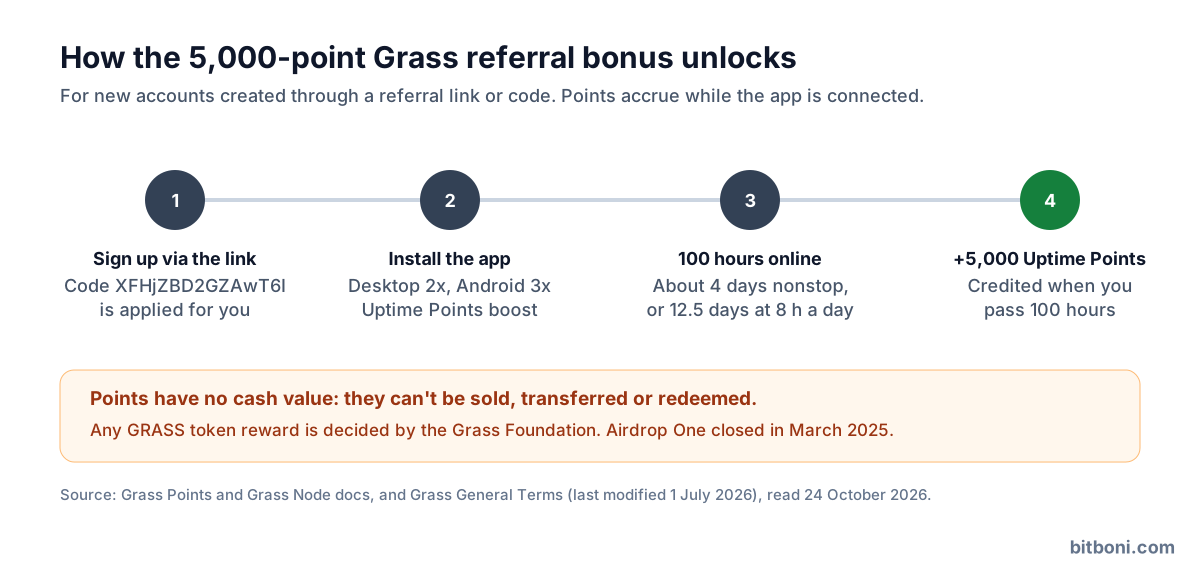
Sign up through our link and the code XFHjZBD2GZAwT6I is applied for you. New referrals receive a 5,000 Uptime Point bonus when they reach 100 hours of uptime: about four days of nonstop connection on one device, or 12.5 days at eight hours a day. There's nothing else to do and nothing to pay.
Disclosure: XFHjZBD2GZAwT6I is our own code. Grass credits us 20% of the Uptime Points you earn for as long as you use it, plus 2,500 Uptime Points when you reach 100 hours. Network Points aren't part of the referral scheme.
What points have turned into so far
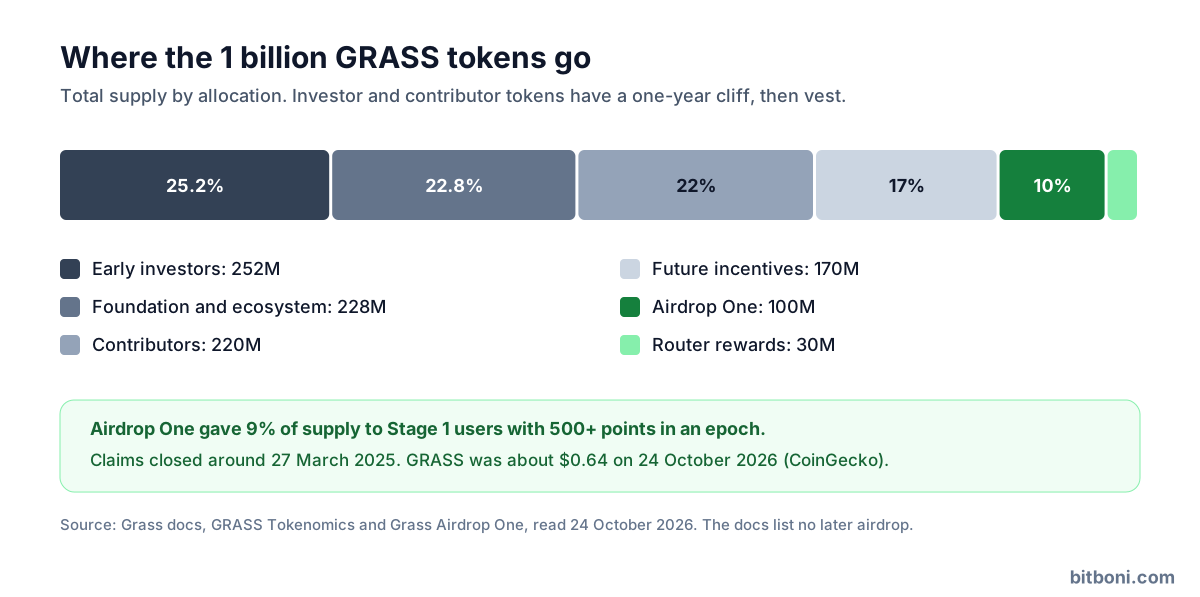
GRASS has a fixed supply of 1 billion tokens. Airdrop One, the first distribution, handed out 100 million (10%): 9% to users who earned more than 500 points in any Stage 1 epoch, 0.5% to GigaBuds NFT holders and 0.5% to Desktop Node and Saga app users. Claims opened on 28 October 2024 and the extended window closed around 27 March 2025; how and when people were paid depended on their country.
The rest is split between early investors (25.2%), the Foundation and ecosystem (22.8%), contributors (22%), future incentives (17%) and router rewards (3%). Future incentives fund retroactive programmes for contributors, the pot any later reward for points would most likely come from, but Grass's docs set no date, size or points-to-token rate for another airdrop. GRASS holders can also stake with routers, with a seven-day unstaking period.
What it's worth: a realistic example
Points have no published value, so any figure is a guess. What we can say: the 5,000-point referral bonus alone clears the Silver rank at 2,595 and gets you nearly halfway to Gold, and on Grass's example of 10 GB a day out of 100,000 GB, a connection would collect about 100 Network Points a day, roughly 3,000 a month, on top of its uptime.
For scale on the token side, Airdrop One's 90 million GRASS for Stage 1 point earners would be worth about $57 million at the $0.635 price on 24 October 2026, shared among everyone who passed 500 points in an epoch. Nobody can tell you what today's points will convert to, if anything. Run it because it costs you little, not because you've budgeted the result.
Devices and boosts
Grass runs as desktop apps for Windows, Mac (Apple silicon and Intel) and Linux, and as an Android app from its own site or the Solana dApp Store; the download page has no iPhone app. The node docs give Android a 3x and the desktop apps a 2x Uptime Points boost, so a spare Android phone left on Wi-Fi and a charger builds uptime fastest.
The Chrome extension, now called Grass Lite Node, still exists, with 900,000 users and a last update on 4 September 2026, but the docs' boost table lists only the apps, which makes them the better choice for earning. A device only earns while it's online, so a laptop that sleeps at night stops counting until it wakes.
Your internet provider and the rules
Grass's terms say plainly that Grass isn't your internet provider and that making sure it doesn't breach your contract with your provider, or any other agreement, is entirely your responsibility. Many home broadband contracts restrict sharing the connection, and capped or mobile plans pay for every gigabyte it uses, so read yours before installing.
You can't use Grass if you're under the age of majority where you live, in a sanctioned jurisdiction or anywhere it's illegal, and using a VPN to get around those restrictions is banned. Points can't be sold, lent, transferred or used to pay for anything, and Grass says neither its claim site nor its staff will ever ask for your private key; the only official claim site has been grassfoundation.io.
What users complain about
On 24 October 2026 the Grass Lite Node extension was rated 2.5 from 2,900 ratings in the Chrome Web Store. The desktop and Android apps come from Grass's own site and the Solana dApp Store rather than Google Play or Apple's App Store, so there's no mainstream store rating to compare.
Recent extension reviews are dominated by one-word accusations of a scam and by users saying their node stopped earning in 2026 with nothing to show for years of uptime. The fair reading is that people who expected points to become money on a schedule are disappointed, because Grass never set one.
Setting up and leaving
Open our link, sign up with an email address or Google account, then download the app for your device and sign in; it shows a connected status while it earns. A wallet only matters if a token distribution needs one: Airdrop One required users to link a wallet in the dashboard before its snapshot. Never share that wallet's private key with anyone.
To stop, pause or disconnect in the app, then uninstall it. There's no balance to withdraw, because points aren't money. Check your data usage after the first week so you know what Grass actually takes from your connection.
Who should use it, and who should skip it
Use it if you have an unmetered connection, an always-on Android phone or computer, a provider that allows sharing, and the patience to treat points as a free option on a possible future token distribution.
Skip it if you're on a capped or mobile data plan, your contract bans sharing, you can't accept strangers' requests leaving through your IP address, or you need income you can count on. Don't buy hardware or upgrade your broadband for it.
FAQ
- What does the Grass referral code give me?
- 5,000 Uptime Points once your account reaches 100 hours of uptime. Signing up through our link applies code XFHjZBD2GZAwT6I for you.
- How long do 100 hours take?
- About four days if a device stays connected nonstop, or 12.5 days at eight hours a day.
- Can I cash out Grass Points?
- No. Points have no monetary value and can't be sold, transferred or redeemed. Only a token distribution decided by the Grass Foundation has ever turned them into GRASS.
- Will there be another airdrop?
- Grass's docs don't schedule one. 17% of the supply is set aside for future incentives, but there's no date, size or conversion rate.
- Is Grass safe to run?
- Grass says it only routes public web requests through your IP address and can't see what you do on your device. The traffic still leaves under your IP address, so keep it off work machines and devices you can't secure.
- Does my internet provider allow it?
- Check your contract. Grass's terms make you solely responsible for any breach of your agreement with your provider.
- Which device earns the most?
- Android gets a 3x Uptime Points boost and the Windows, Mac and Linux apps 2x. There's no iPhone app.