


Hyperbeat Pay Review: A Self-Custodial Visa Card That Borrows Against Your Crypto
Hyperbeat Pay reviewed: how the Liquid Bank account and virtual Visa card work, Cash and Credit modes, loan-to-value and liquidation, real fees and cashback, bank deposits and withdrawals, supported countries, the terms and who should skip it.
Last updated 31 October 2026
Best for
Crypto holders outside the UK, in a supported country, who want to spend stablecoins or borrow against BTC, ETH, SOL or HYPE with a card while keeping the keys themselves, and active Hyperliquid traders who can unlock the higher cashback tiers.
A well-built bridge between a self-custodial wallet and a Visa card, with clearly published pricing and real risks. Cash mode is the safe part: spend dollars you hold, pay 0.4%–1% on foreign currency, earn 0.2%–1% back in WHYPE. Credit mode is a loan with no grace period, and at Hyperbeat's own example a 22% fall in BTC turns a $5,000 card bill into $5,634 of your BTC handed to a liquidator. The wallet is yours, which removes the freeze risk that haunts custodial crypto cards, but nothing is deposit-insured, the app is only months old, and the card terms allow fees well above the help-centre figures. There is no sign-up bonus. Use it in Cash mode first, keep any Credit-mode loan far below the limit, and treat cashback as a small extra rather than the reason to join.
Pros
- Free virtual Visa cards, up to 20, for Apple Pay and Google Wallet
- Self-custodial smart wallet controlled by your passkey, recoverable by email and exportable to MetaMask or Rabby
- Credit mode spends against BTC, ETH, SOL, HYPE, gold or USD+ without selling them
- Published FX fee of 0.4%–1% on non-USD purchases
- 0.2% cashback on everything, up to 1% with modest boosters and 3%–12% for heavy Hyperliquid traders
- USD account details and a EUR IBAN for bank deposits and withdrawals in many countries
Watch-outs
- No sign-up bonus for joining with a code
- Credit mode has no interest-free period and liquidates crypto collateral with a 12.68% bonus to the liquidator
- No deposit insurance on USD or USD+ balances; smart-contract risk applies
- Card terms allow FX and cross-border fees of up to 3% each, and limits can be cut to $0 without notice
- Virtual cards only; fuel pumps, jewellers and cash-like payments are blocked
- Young product with few app ratings, and not available to UK residents
Current related offer
Hyperbeat offer pageReferral links: BitBoni may earn a commission when you sign up.
Provider
Hyperbeat
Open a Hyperbeat Liquid Bank account with code GETQUIDS for a free virtual Visa card that spends your dollar balance, or borrows against BTC, ETH, SOL or HYPE without selling. There is no sign-up bonus; everyday cashback runs from 0.2% to 1%, paid in WHYPE.
Requirement: Sign up with code GETQUIDS and pass identity checks; no minimum deposit or spend
KYC countries: Open in 80 countries
Medium10 minutes to sign up and verify; card issued in the app straight after approvalPayout No sign-up bonus to pay out. Card cashback (0.2%–1% for everyday users) lands in your account as WHYPE once each purchase clears, which takes up to 48 hours.
Verified 31 October 2026
Full claim instructions are on the Hyperbeat offer page.
What Hyperbeat Pay is
Hyperbeat started as a yield and staking protocol on Hyperliquid, the crypto exchange chain. On 8 April 2026 it launched Liquid Banking: a Liquid Bank account, which is a smart wallet on HyperEVM created when you sign up and controlled only by your passkey, plus Hyperbeat Pay, a Visa card that spends from that wallet. The same account holds savings in USD+, trades Hyperliquid spot and perpetual futures, and moves money in and out of banks. The operator is Zoeion Ltd Corporation; Third National issues the card.
You can run it in a browser at app.hyperbeat.org or in the Hyperbeat Pay apps for iOS and Android. Sign-up takes an email, a passkey and an identity check with a passport or national ID and a selfie, which Hyperbeat says usually clears in about two minutes. Virtual cards are free and issued instantly, up to 20 at a time; the physical card is still marked coming soon.
Cash mode and Credit mode
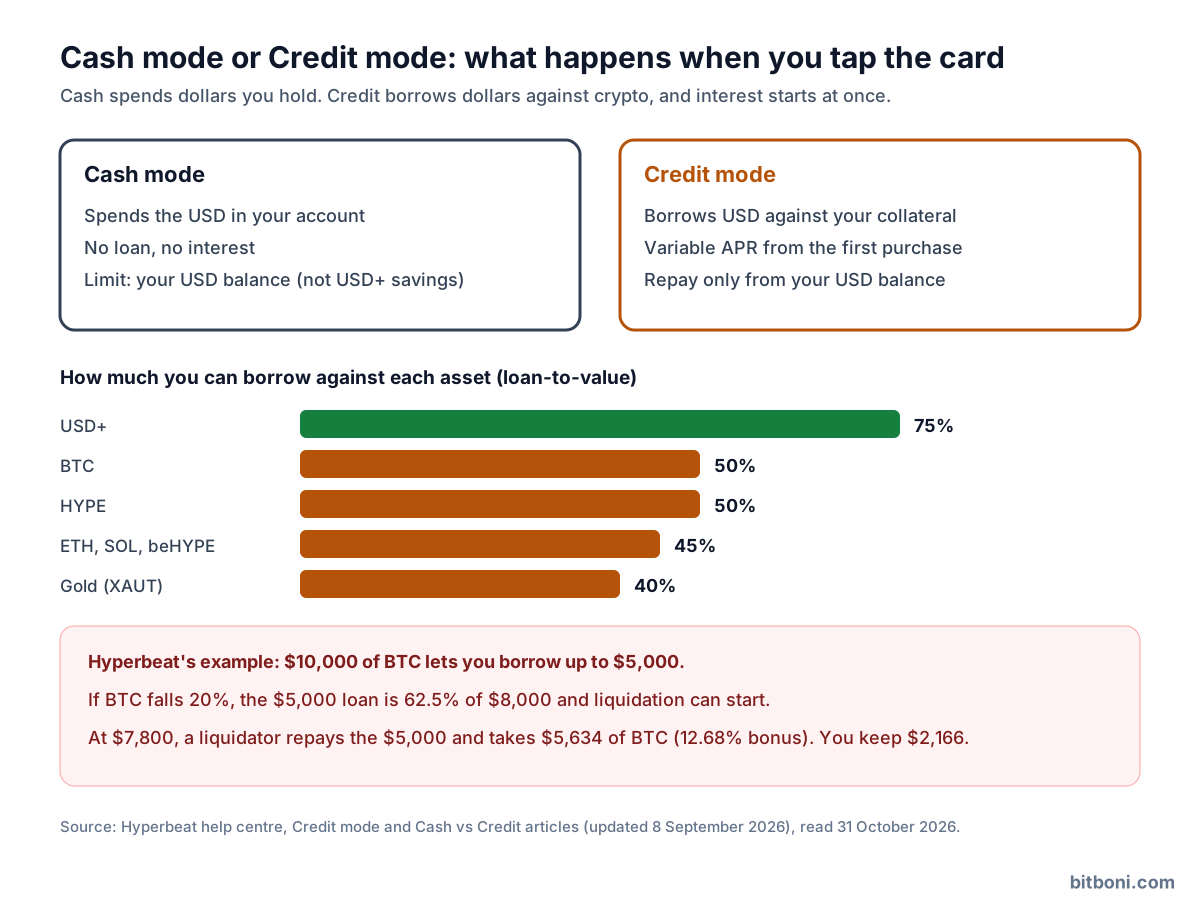
Every card purchase settles in one of two modes. Cash mode spends the dollars in your account, with no loan and no interest; your limit is simply your USD balance, and USD+ savings don't count. Credit mode borrows dollars at the moment you pay, against collateral in your account, through lending markets run on Morpho. You keep the crypto; you owe the dollars.
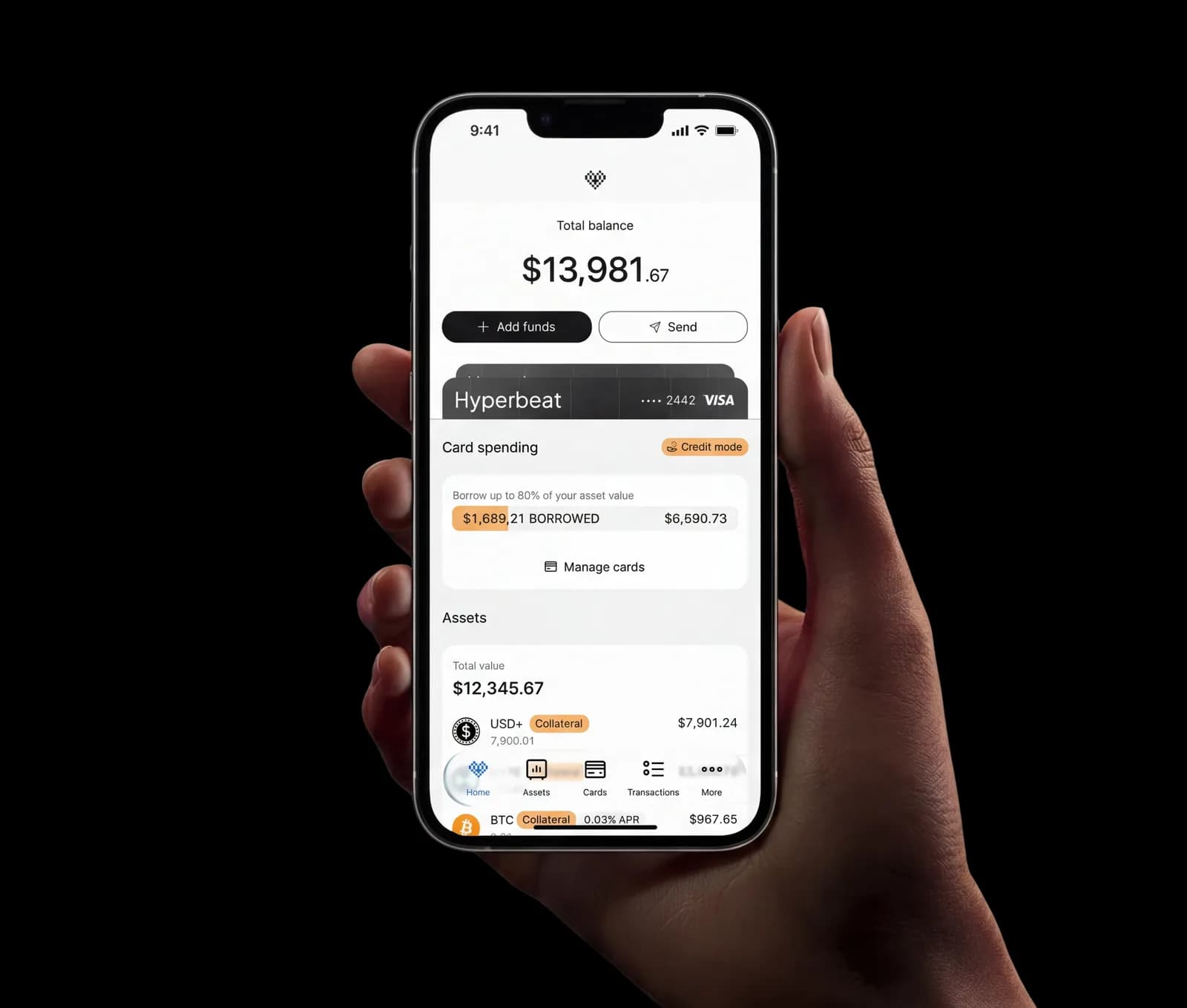
Credit mode is where the risk sits. Interest is a variable rate shown in the app, it starts the moment you spend and compounds continuously, and there is no billing cycle or grace period. You can repay only from your USD balance, not by selling collateral yourself. If your loan reaches 62.5% of your collateral's value, liquidators can repay debt and take collateral plus a 12.68% bonus. Hyperbeat's marketing image says "borrow up to 80%"; the limits in its help centre are 75% for USD+, 50% for BTC and HYPE, 45% for ETH, SOL and beHYPE, and 40% for gold.
What it costs: a worked example
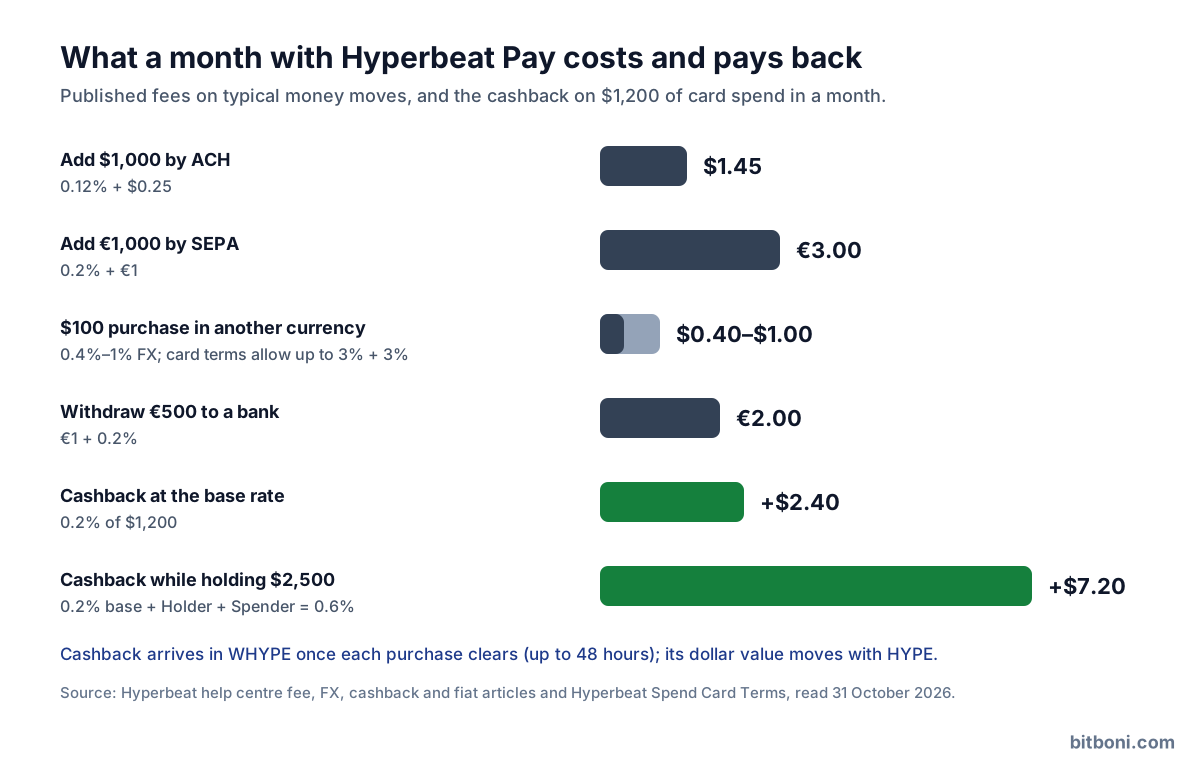
Hyperbeat's help centre lists a foreign-exchange fee of 0.4%–1% on non-USD purchases, on top of Visa's rate, so a $100 purchase in euros or yen costs 40 cents to $1 extra. Paying in the local currency matters: a terminal that offers to charge you in dollars adds its own markup. The card terms are looser than the help centre, allowing up to 3% FX plus up to 3% cross-border, so check the fee on your first foreign purchase. ATM withdrawals are listed at $1 plus 0.65%, with $0.60 for balance checks and declines, but there is no physical card yet and Hyperbeat's blocked-merchant list includes ATM cash, so don't plan on cash.
Moving money in and out has small published fees: 0.12% plus $0.25 for a US ACH deposit, 0.12% plus $18 for Fedwire, 0.2% plus €1 for SEPA, and on the way out $0.25 plus 0.12% for USD by ACH, €1 plus 0.2% for euros and £1 plus 0.25% for sterling. Adding $1,000 by ACH costs $1.45; withdrawing €500 costs €2. USD+ savings charge 10% of the yield earned and nothing to deposit or withdraw. Hyperliquid trading adds a 0.025% Hyperbeat builder fee on top of Hyperliquid's own fees.
Cashback: what you'll actually earn
Everyone earns 0.2% on card spend from the first purchase. Four boosters each add 0.2%: holding $1,000 in USD or USD+, holding $10,000, spending $1,000 on the card in the last 30 days, and spending $10,000. Hyperbeat's own example, holding $2,500 and spending $1,200 a month, earns 0.6%, about $7.20. Reaching the 1% ceiling needs $10,000 held and $10,000 of monthly spend.
The headline 3%–12% rates are for traders. Trading $1 million on Hyperbeat's Hyperliquid interface over 30 days earns 3% on up to $3,300 of spend; $50 million earns 12% on up to $41,700. Spend above the cap drops to your everyday rate. Cashback is paid in WHYPE, wrapped HYPE, once each purchase clears, which takes up to 48 hours; its value rises and falls with the HYPE price.
Getting money in and out
Crypto is the native route. Send native BTC, ETH or SOL to the deposit address in the app and it arrives as a Hyperliquid version of that coin (UBTC, UETH, USOL), usable as collateral at once. Withdrawals go out on HyperEVM, so taking BTC back to the Bitcoin chain means moving it through Hyperliquid first.
Bank deposits run through Noah, Hyperbeat's payments partner, after a one-time extra check. You get US account and routing numbers (issued through Lead Bank, Member FDIC) and, in many countries, a euro IBAN; up to $10,000 per deposit. Each deposit converts to your crypto dollar balance and waits for you to tap Sign to finalize, so the FDIC line covers the receiving account, not your Hyperbeat balance. Withdrawals pay out in more than a dozen currencies, including USD, EUR, GBP, AUD, AED, BRL, MYR, NGN, PHP, THB and ZAR, depending on where you live.
Where your money sits
Your balance lives in your own smart wallet. Hyperbeat says it can see the balance but cannot move, lock or freeze it, and that you can reach your funds without the company: recover the wallet by email through Turnkey, the key-management service behind the passkey, or export the key into MetaMask, Rabby or a Ledger. Credit-mode collateral sits in Morpho smart contracts and comes back automatically when you repay. That is a real difference from custodial crypto cards, whose terms usually let the company hold your money during a dispute.
Self-custody isn't insurance. Your dollar balance and USD+ are crypto assets with no deposit protection; USD+ earns its target 3%–8% by lending to Credit-mode borrowers, and withdrawals take up to 24 hours. Smart-contract bugs, oracle errors and stablecoin failures are your risk. And the card is not self-custodial: Hyperbeat and the issuer can lower your limit to $0 or revoke cards without notice, and they do for anyone farming free trials.
Who can sign up
Hyperbeat lists about 50 supported countries for the card, including Europe, Hong Kong, Japan, Singapore, Malaysia, Thailand, the Philippines, Australia, New Zealand, the UAE, Nigeria, Kenya, South Africa, Mexico, Brazil, Argentina and much of the Caribbean, plus 35 US states. It excludes Belarus, mainland China, Cuba, India, Indonesia, Iran, Iraq, Israel, Myanmar, Nepal, Nicaragua, North Korea, Russia, Syria, Turkey, Ukraine, Venezuela and Vietnam, and 16 US states; its terms also bar Ontario. Bank accounts have their own country list.
The UK isn't on the card list, UK residents can't open the bank accounts, and the iOS app isn't in the UK App Store. Your country is set by the residence you confirm during identity checks, not where you travel. Using a VPN to get around this breaks the terms.
The invite: code GETQUIDS, no sign-up bonus
Hyperbeat ran a referee sign-up bonus until 24 August 2026 and then removed it. Joining with code GETQUIDS today gives you the standard account and card, with nothing extra and nothing taken away: you keep all of your own cashback. Tap Claim on our page and sign up in the same browser; the link stores the code and sends it with your email registration. If a referral-code box appears, check it reads GETQUIDS.
Disclosure: GETQUIDS is our code. Hyperbeat's affiliate programme pays us a share of the revenue it earns from your card and trading activity for 12 months. That comes out of Hyperbeat's share, not your cashback or fees.
Track record and terms
Liquid Banking is months old. The iOS app went live in July 2026 and on 31 October showed 2.75 stars from just four US ratings; the Android app had more than 1,000 downloads. We found no Trustpilot page. Hyperbeat publishes audits of its contracts in its docs. The help centre is unusually detailed, but some articles contradict each other: one says five virtual cards, a newer one says 20, and Wisconsin appears on both the supported and excluded state lists.
The Terms of Use let Zoeion end your access at any time, with or without notice, cap its liability at the lower of six months of platform fees or US$100, and send disputes to arbitration in Panama with no class actions. The card terms, effective 27 November 2025, run under Puerto Rico law with arbitration in New York, show a 0% purchase APR because Credit-mode interest is charged by the lending market rather than the card, and ask you to attest that you weren't solicited for the card. Read both before you deposit more than you would comfortably lose access to for a while.
Who should use Hyperbeat Pay, and who should skip it
Use it if you already hold crypto or stablecoins, live in a supported country, and want to spend them with a card without handing them to an exchange. It suits Hyperliquid traders most: the account trades, spends and borrows in one place, and $1 million of monthly volume lifts cashback to 3%. Keep Credit-mode borrowing well under half your limit, and start with a small deposit to test the deposit and card flow.
Skip it if you want a bank account with deposit insurance, a physical card for fuel or ATMs, or a sign-up bonus. Skip Credit mode if a 20% crypto fall would hurt, because liquidation is automatic and costly. And it isn't for UK residents.
FAQ
- Is there a Hyperbeat sign-up bonus?
- No. Hyperbeat removed the referee bonus in August 2026. Joining with code GETQUIDS gives you the standard account and card and costs you nothing.
- Is Hyperbeat Pay a debit card or a credit card?
- Both, by mode. Cash mode spends the dollars you hold, like a debit card. Credit mode borrows dollars against your crypto each time you pay, with interest from the first second.
- How much can I borrow against my BTC?
- Up to 50% of its value. Liquidation can start when the loan reaches 62.5%, so at the maximum a 20% fall in BTC puts your collateral at risk.
- Can Hyperbeat freeze my funds?
- Hyperbeat says no: the wallet is self-custodial and only your passkey moves funds, and you can recover it by email or export it to another wallet. It can still revoke cards, cut card limits and end your access to its app.
- What does Hyperbeat Pay charge abroad?
- Its help centre lists 0.4%–1% on non-USD purchases. The card terms allow up to 3% FX plus up to 3% cross-border, so check your first foreign purchase.
- How is cashback paid?
- In WHYPE, once each purchase clears, which takes up to 48 hours. The rate is 0.2% to 1% for everyday users and 3% to 12% on capped spend for active Hyperliquid traders.
- Is there a physical Hyperbeat card?
- Not yet. Virtual cards are free and work with Apple Pay and Google Wallet; the physical card is listed as coming soon.
- Can I use Hyperbeat Pay in the UK?
- No. The UK isn't a supported card country, UK residents can't open the bank accounts, and the iOS app isn't in the UK App Store.